
White paper, second installment of the Babel / Inflexión series, companion to
04-whitepaper-babel.md. Style: Chicago author-date via pandoc + BibTeX. Voice: essayistic for curious minds. Citations are BibTeX keys ([@key]) and resolve through the sharedreferences.bibin the Babel repository.
1. The design move
Programming languages with a flavour of natural language are by now an established sub-genre of the esoteric-programming-language wiki (Esolangs Contributors 2026). The genre includes Shakespeare’s plays as syntax, Chef’s recipes as syntax, ArnoldC’s action-movie quotes, LOLCODE, and the English-like rule statements of Inform 7 (Nelson, n.d.). Almost all of them are English. The handful that engage material from other languages do so almost exclusively at the level of vocabulary. Mierda (Esolangs Contributors, n.d.-c) and Chespirito (Esolangs Contributors, n.d.-a) in Spanish, La Weá (Esolangs Contributors, n.d.-b) in Chilean Spanish, BIRL in catchphrases flavoured by Brazilian Portuguese, and Monicelli in mock-Italian are reskins of an existing execution model, with culturally specific keywords replacing the canonical ones. The execution model itself remains a Brainfuck tape, a stack machine, or some other widely re-implemented base.
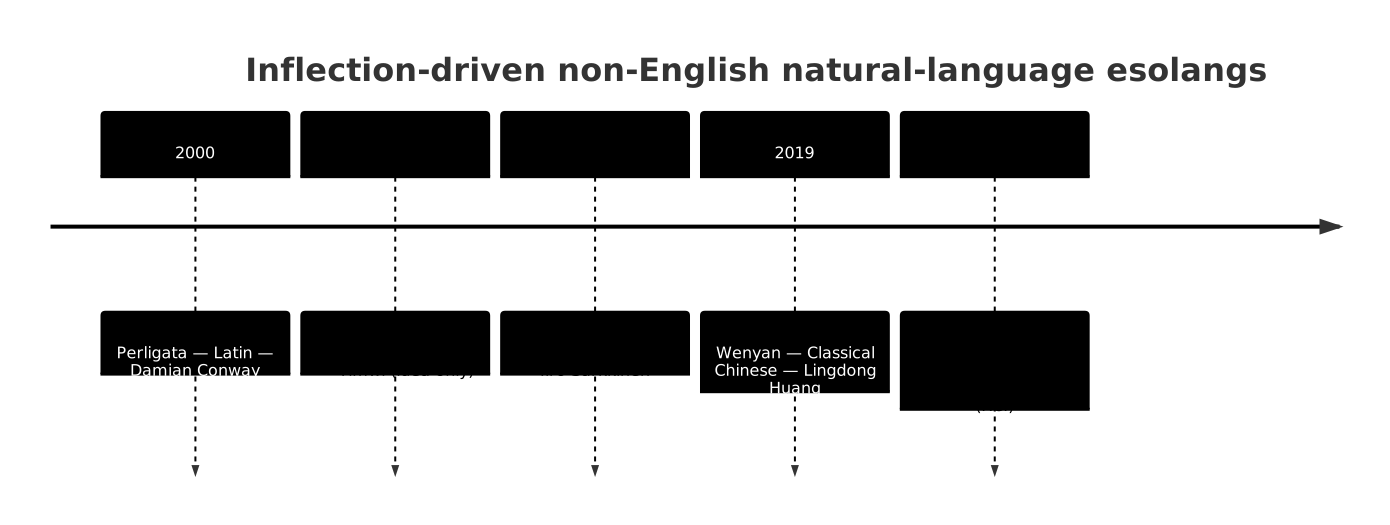
A small but real lineage of esoteric languages does something structurally different. Lingua::Romana::Perligata (Conway 2000), Damian Conway’s Perl module built on Latin grammar from the year 2000, is the canonical precedent for treating inflection as semantics. In Perligata, declension determines variable type. A scalar is a neuter-singular second-declension noun; an array is its plural; a hash takes a different declension entirely. Verb conjugation determines call context, and free word order is permitted exactly because the inflectional system does the work word order does in English. Wenyan (Huang 2019), Lingdong Huang’s Classical Chinese language from 2019, uses Classical Chinese particles in their literary positions as syntactic structure, with a real parser handling real grammatical constructions rather than a keyword scanner replacing tokens. The relevant particles include 者, 也, and 而. Tampio (Hauhio, n.d.), Iikka Hauhio’s language built on Finnish grammar, in active development since around 2017, uses the libvoikko Finnish morphological analyzer to engage eight noun cases, verb conjugation, postpositions, comparatives, and plural inflection as semantic structure. And Espro (Timwi 2015), an unimplemented 2015 idea page for a language built on Esperanto grammar, sketches accusative-as-field-access and infinitive-as-method conventions without producing a working compiler.
The four together establish a small genre. Latin in Perligata is dead and inflectionally maximal. Classical Chinese in Wenyan is literary and not a living vernacular. Finnish in Tampio is living and agglutinative. Esperanto in Espro is constructed and idea-only. None of the four is a Romance language, and none engages the specific feature set that contemporary Spanish makes available: the copular split between ser and estar, the three-way mood distinction across indicative, subjunctive, and imperative, the contrast in aspect between perfective and imperfective, the fixed-order Spanish clitic system, and productive morphology for diminutives and augmentatives.
This paper proposes a language that joins the lineage rather than opens it. Inflexión, referred to throughout under that name, resolved 2026-05-09 and discussed in §12, uses the grammatical features of Rioplatense Argentine Spanish as the source of programming semantics. The features in play are number, verb mood, verbal aspect, the split between the copular verbs ser and estar, clitic pronoun ordering, and the morphology of diminutives and augmentatives. The features in question are not merely thematic surface; they carry the language’s semantic load. A program in Inflexión that reads as Spanish prose to a reader who speaks Spanish is, simultaneously, a program in which number, mood, aspect, and copular choice are determining what the program does.
What Inflexión adds to the existing lineage, to the best of our knowledge, is two things. First, it is the first language driven by inflection on a living Romance natural-language substrate. Second, it is the first to make the split between ser and estar, the distinction in mood across subjunctive and indicative and imperative, the contrast in aspect between perfective and imperfective, the Spanish system of clitic ordering, and productive morphology for diminutives and augmentatives jointly load-bearing as semantic primitives. Each is documented in standard Spanish reference grammars; none has been carried into programming-language design before, in this combination, that we have found. The contribution is also, secondarily, a hypothesis about the relationship between grammatical density and prompting density in large language models, deferred to §6. The two contributions are independent: the language is interesting on its design merits whether or not the hypothesis bears empirical weight.
2. Why Spanish, and which Spanish
Spanish is one of the most grammatically dense among the major Romance languages, and the Romance languages themselves sit between the heavily analytic, like English and Mandarin, and the heavily agglutinative, like Finnish, Turkish, Quechua, and Hungarian, on the typological spectrum of how much grammatical information a single word can carry. A conjugated Spanish verb encodes person, number, tense, mood, and aspect in a single morphological complex. Comeríamos is ten letters of Spanish that take two to three words of English to express, we would eat, and that carry information English does not mark at all, namely the conditional mood and a particular aspect of the unrealised action. Hablándomelo, the present participle of hablar with two enclitic pronouns, encodes the action, its progressive aspect, and the indirect and direct objects of that action in a single space-free token of twelve letters. These are extreme examples; the typical Spanish verb form in everyday speech still encodes more grammatical information per token than the typical English equivalent.
The relevant features of Spanish for the present design choice are:
- Number marked on nouns, articles, adjectives, and verbs, with strict agreement. Singular and plural are morphologically distinct on essentially every word that can take inflection.
- Verb conjugation by person, number, tense, mood, and aspect. Approximately fourteen tenses across three moods.
- A clean distinction in aspect between perfective and imperfective in the past tense, as in comió and comía, which English collapses into ate.
- Robust subjunctive mood, used for hypothetical, desired, doubted, or unrealised actions. Productive in living speech in a way it largely is not in modern English.
- The split between ser and estar, two copulas distinguishing essential or defining properties (es) from transient or located states (está).
- Clitic pronoun ordering in fixed sequence: object pronouns me, te, se, lo, la, le, nos, os, les attach to the verb in a grammaticalised order when multiple clitics co-occur.
- Productive morphology for diminutives and augmentatives: -ito, -ita, -illo, -illa, -ón, -azo, -ote. Carries meaning beyond literal size, including affection, contempt, intensity, and casualness, and applies to nouns, adjectives, and a smaller range of other parts of speech.
These six features are the design surface this paper works from. Each becomes the basis for one of the mappings from grammar to semantics in §3.
The choice of which Spanish matters. There is no neutral Spanish in the way there is a relatively neutral standard written English. The principal regional varieties differ in pronoun systems, verb forms, lexicon, and intonation. The principal varieties are peninsular in Spain, Mexican, Rioplatense in Argentina and Uruguay and parts of Paraguay, Andean, Caribbean, and Chilean. The choice in La Weá to be specifically Chilean rather than generically Spanish in flavour (Esolangs Contributors, n.d.-b) is the right precedent at the level of strategy: a dialect-specific design decision is more honest than a default to Castilian, and it allows the language to inherit features that exist in some dialects but not in others.
Inflexión is Rioplatense. The reasons are four. First, the author is in active re-acquisition of Spanish through immersion in Rioplatense in Argentina, after a long period as an English professional and after originally growing up speaking Venezuelan Spanish. The dialect chosen is the dialect being heard, used, and consciously absorbed daily, which makes it the live register the language design has access to. Native fluency in Venezuelan Spanish underneath, conscious re-acquisition of Rioplatense on top, is precisely the position from which the morphological mechanics become visible. See the predecessor article Listening to Spanish Again for that observation in essay form. Second, Rioplatense uses vos in the second-person singular instead of tú, with distinctive verb forms like vos comés, vos hacés, vos tenés that are absent from peninsular and Mexican Spanish; the language can use these as syntactic markers without competing with peninsular norms. Third, Rioplatense has substantial intonation derived from Italian and lexicon drawn from lunfardo, which has produced a distinctive register that resists easy assimilation to a “neutral” Spanish; being a named dialect rather than a defaulted one is part of being honest about what the language is. Fourth, the linguistic ecology of Argentina described in the inspiration document, a country with unusually preserved pockets of regional and immigrant language, gives the dialect choice a specific cultural anchor that a non-located choice would lack.
Naming the dialect choice is itself a design move. A reader who picks up Inflexión knows from the first page what register they are reading in, what verb endings to expect, and what cultural specificity the language is assuming. The choice rules in some readers and rules out others, deliberately and openly.
3. The mappings from grammar to semantics

Six grammatical features of Rioplatense Spanish, each mapped to a role in programming semantics. The mappings are deliberate, and where multiple plausible mappings exist for a feature, the choice made here is justified rather than asserted.
3.1 Ser vs estar → immutable vs mutable binding
Spanish has two copulas where English has one. Ser attributes essential or defining properties, what something is, by nature, persistently. Estar attributes transient or located states, where something is, how it happens to be right now, what state it is currently in. La nieve es blanca, snow is white by nature, versus la nieve está sucia, the snow is dirty in its current state.
In Inflexión, this maps with no friction at all to the distinction between immutable and mutable binding.
A binding made with ser, as in el resultado es 42, is immutable. The name resultado refers to 42 essentially and forever in this scope; subsequent lines cannot change what resultado means.
A binding made with estar, as in el contador está en 0, is mutable. The name contador refers to a cell whose current value is 0, but whose value can be subsequently changed. Mutation requires the imperative, as in hacé que el contador esté en 1; reads can use the indicative, as in the query ¿el contador está en 1?, with the Spanish opening question mark.
The pedagogical effect, again, is that immutability is visible at the binding site through the choice of copula. There is no syntactic hint required, no let versus const, no var versus val, beyond the natural-language grammar the language already uses. A reader of Inflexión who speaks Spanish knows immediately, from the verb, whether they are looking at a defining bind or a current-state bind. This is the cleanest of the six mappings, and the one most likely to read naturally to a programmer who speaks Spanish and has no prior exposure to Inflexión.
3.2 Mood → evaluation strategy
The clearest illustration of why mood matters semantically is the flip between indicative and subjunctive on negation. Creo que viene mañana, I think he’s coming tomorrow, uses the indicative viene. Negate the belief: No creo que venga mañana, I don’t think he’s coming tomorrow, and the embedded verb shifts to the subjunctive venga. When you affirm a belief you are committing to the embedded clause as fact, and Spanish marks asserted reality with the indicative; when you negate the belief, you are no longer committing, the embedded clause is not being asserted, and Spanish marks unasserted clauses with the subjunctive. The mood marks the speaker’s stance toward what they are saying, not just the literal content. English does not encode the distinction in the verb form; Spanish does.
Spanish marks three principal moods on its verbs. Each maps to a different evaluation strategy in Inflexión.
Indicative mood denotes asserted reality. In Inflexión, statements in indicative mood are evaluated immediately and unconditionally when control reaches them. El contador está en 0 binds contador to 0 the moment the line executes. This is the default mood and the closest to how mainstream programming languages handle assignment and expression evaluation. The choice of estar rather than ser is a separate semantic decision documented in §3.1; estar makes the binding mutable, which a counter typically wants to be.
Subjunctive mood denotes hypothetical, desired, doubted, or unrealised reality. In Inflexión, statements in subjunctive mood are deferred: they are evaluated only when their triggering condition is realised, and their resulting state is bound to the realisation of that condition. Cuando el contador esté en 10 establishes a deferred binding that will fire when contador reaches 10; the binding is itself a first-class value that can be passed, composed, and inspected before it fires. The subjunctive becomes the language’s mechanism for expressing futures, promises, conditions, and reactive bindings, all under one syntactic banner.
Imperative mood denotes commands. In Inflexión, statements in imperative mood perform side effects: I/O, mutation of mutable bindings, communication with the environment. The imperative is segregated from the indicative, in the sense that pure expression evaluation does not perform effects; effects require the imperative. Decí “hola”, the vos imperative of decir, writes “hola” to standard output as a side effect; the same word as an indicative third-person form, dice “hola”, would be an expression that describes the saying of “hola” without actually performing it.
This three-way split in mood unifies, under a single grammatical category natural to Spanish, what mainstream languages handle through three distinct mechanisms: synchronous evaluation, deferred or lazy or reactive constructs, and effect systems. A reader of Inflexión can see at a glance, from the verb form alone, whether a line is doing something now, promising something for later, or commanding the environment.
3.3 Aspect → eager vs lazy, completed vs ongoing
Spanish marks two aspects in the past tense: perfective in the preterite, a completed action viewed as a whole, and imperfective in the imperfect, an ongoing or habitual action viewed in its duration. English collapses both into the simple past ate; Spanish keeps them apart morphologically, as in comió versus comía.
In Inflexión, aspect is the distinction between eager and lazy evaluation at the level of individual function calls. A verb in perfective aspect, as in calculó la suma, requests immediate, eager evaluation: the call runs to completion and returns its value. A verb in imperfective aspect, as in calculaba la suma, requests lazy or streaming evaluation: the call returns a thunk, a generator, or a stream of partial results, depending on the operation, and the consumer drives it forward as needed.
The same operation can be invoked under either aspect, and the choice is made syntactically by the verb form rather than by separate library APIs. Sumó los números sums them now; sumaba los números gives back a stream of running sums. The reader of the code sees the choice in the verb morphology itself, not in surrounding context.
For the common case where eager evaluation is wanted and the choice of aspect does not need to be marked, Inflexión accepts the bare infinitive as a shortcut: sumar los números is equivalent in semantics to sumó los números. The infinitive form is morphologically unmarked for aspect; the language convention is that unmarked aspect defaults to perfective, i.e. eager. When laziness is wanted, the imperfective form must be used explicitly. The shortcut keeps everyday function-call expressions short; the explicit form is available when the aspect choice matters or when the code wants to make the choice visible to the reader.
This mapping has the pleasing property that Spanish speakers already use the distinction between perfective and imperfective to convey exactly this sense of “complete” versus “ongoing” in everyday speech. The programming-language semantics inherits a distinction that is already cognitively available to its readers; Inflexión does not have to teach the distinction, only to extend it into the computational domain.
Aspect is the smallest of the six mappings. The other five each ask the reader to learn a new structural feature: ser / estar commits binding to mutability, mood encodes evaluation stance, clitics route arguments, diminutive suffixes scale numerics, number runs through articles and verbs in lockstep. Aspect is one morphological choice on a verb the programmer was already going to write, -ó versus -aba, -ió versus -ía. Two letters or three, one decision, the entire semantic distinction between eager and lazy delivered.
3.4 Clitic ordering → argument shuffling
When multiple object pronouns attach to a verb in Spanish, they appear in a fixed grammatical order: se before second-person before first-person before third-person, and within each person indirect before direct. Dámelo, “give-it-to-me”, combines the imperative dá, the vos form of dar, with the indirect-object clitic me and the direct-object clitic lo in their required order. Dáselo, “give-it-to-him/her/them”, is the parallel imperative, substituting se for me. The order is grammaticalised; lome dá is not Spanish.
In Inflexión, the clitic stack on a verb specifies the routing of arguments through a function call. The verb names the operation; the clitics, in their fixed Spanish order, name the arguments in their corresponding positions. Different clitic combinations call different specialisations of the same function, partially apply, or curry. This gives the language a syntactic combinator system that is already cognitively familiar to Spanish speakers as the way object pronouns work in everyday speech. Clitics encode person, across first and second and third, and role, across direct object and indirect object and reflexive; they do not carry semantic load beyond those two dimensions.
The fixed order matters: it means that the clitic stack is a positional system for routing arguments, not a keyword-argument system, and that the language inherits a particular discipline of how arguments compose. Dámelo and dáselo are both two-argument calls of dar, but with different recipients; the difference is morphologically marked through the substitution of me with se. A function written to accept clitic-routed arguments must accept a fixed sequence of slots, in the Spanish order, and the call site indicates which slots are filled by which values through the clitic morphology.
Parenthesised arguments and recursion, added in Phase 7. When a function call appears as an argument to another function, particularly in recursive calls, Spanish prose allows parenthesisation to disambiguate the call boundary. The form fact (el n menos 1), with the parentheses grouping the argument el n menos 1 to fact, is the minimal disambiguation we believe necessary. The alternative form fact del n menos 1 without parentheses was rejected as still subject to greedy argument parsing: the parser would tend to extend the argument across the menos 1, binding the entire phrase as a single argument to an outer call. Parenthesisation is a small concession to parsing clarity in an otherwise postfix system following Spanish order, required because recursive calls would otherwise become syntactically ambiguous. The feature is new as of Phase 7 and handles the case where a function call must appear in argument position within another invocation.
This is the most syntactically novel of the six mappings and the one a reader from the curious-minds audience is most likely to find unfamiliar. A worked example in §5 exercises it.
3.5 Diminutive and augmentative → numeric and computational scaling
Spanish suffixes for diminutives, -ito, -ita, -illo, -illa, and for augmentatives, -ón, -ona, -azo, -ote, are productive and apply to nouns, adjectives, and a smaller range of other parts of speech. Casa / casita / casón is house / little house / big house. Rápido / rapidito is fast / quickly, with the diminutive carrying a casual, slightly affectionate register. The suffixes carry meaning beyond literal size: affection, intensity, casualness, contempt. A separate intensifying construction, the absolute superlative -ísimo, as in rapidísimo, “extremely fast”, is morphologically distinct and not part of this mapping.
In Inflexión, morphology for diminutives and augmentatives applies to numeric values and to function invocations as a scaling operator.
On a numeric value, cinco is 5; Inflexión applies the morphology for diminutives and augmentatives to the numeral itself. Cinquito is 5 halved, namely 2.5; cinquillo is 5 quartered; cincón is 5 doubled; cincazo is 5 quadrupled. These are coined extensions: standard Spanish does not normally apply diminutives to numerals, and the resulting forms are internal to Inflexión rather than dictionary words. Native speakers will recognise the suffixes immediately even where the resulting token is novel. One collision worth flagging: cinquillo is a real Spanish word in card-game and music-notation contexts, where it names a group of five. Inflexión repurposes it for 5 quartered and accepts the homonym rather than avoiding it. The scaling factors themselves are conventional and chosen by the language, not derived from the suffix’s natural-language meaning, which is too vague to ground a numeric semantics on. Programs that need precise scaling can use explicit multiplication; the diminutive and augmentative are a cheap way to express common scaling moves.
On a function invocation, the diminutive marks a cheap or low-cost variant of the operation, and the augmentative marks an expensive or thorough variant. Buscar, to search, is the default; busquito is a quick approximate search; buscazo is a thorough exhaustive search. As with the numeric case, busquito and buscazo are coinages. Spanish applies diminutives to verbs occasionally in informal speech, as in cantarcito, a little singing, but does not have a standard convention for applying them to denote computational cost. The implementation can choose what these labels mean concretely; the language commits to the discipline that diminutive and augmentative mark cost-and-thoroughness, and the implementer commits to choosing labels honestly.
This is the most playful of the six mappings, in the sense that the cultural register of diminutive Spanish, with its affectionate, casual, in-group warmth, bleeds into the code’s character. Programs in Inflexión that lean on diminutive scaling read as friendlier than equivalent programs in a language without the construction. Whether this is a virtue or a vice is a question for users to settle through use.
3.6 Number → scalar vs collection
Spanish marks number, singular versus plural, on nouns, articles, adjectives, and verbs, and enforces agreement across all of them. El número es cinco, with singular noun and singular article and singular verb, versus los números son cinco, with plural noun and plural article and plural verb. Disagreement is ungrammatical: los número and el números are not Spanish.
In Inflexión, number maps to the distinction between scalar and collection at the value level. Singular nouns refer to scalar values; plural nouns refer to collections, including lists, vectors, and sequences. Agreement at every syntactic juncture between article, noun, adjective, and verb is the language’s way of making that distinction structurally enforceable.
A binding el contador es 0 introduces a scalar contador. A binding los contadores son [0, 0, 0, 0] introduces a four-element collection. Operations on collections broadcast element-wise: los contadores más uno increments each element of the collection by one; los números por dos doubles each. Operations between a scalar and a collection broadcast the scalar across the collection: el factor por los valores multiplies each value by the single factor. The semantics is influenced by APL and should feel familiar to any reader who has used NumPy, MATLAB, or J.
Where Spanish allows ambiguity in everyday speech, as in los valores son cinco, which could mean “each is 5” or “the collection is the literal 5”, Inflexión fixes the semantics. A scalar literal on the right of a plural binding broadcasts: los valores son 5 assigns the scalar 5 to each element of valores. A collection literal requires explicit collection syntax: los valores son [5, 5, 5] assigns the literal three-element collection. The disambiguation is a small concession the language asks of the programmer in exchange for syntactic regularity.
The mapping inherits a discipline that Spanish speakers already use. A programmer fluent in Spanish does not have to learn that singular and plural differ; the mapping in Inflexión extends a distinction that is already cognitively available into the computational domain. The language pays no surface-form cost, since number marking is part of natural Spanish grammar, and gains a structural invariant that operates as a compact type system without requiring explicit type declarations.
The pedagogical effect is that the distinction between scalar and collection is morphologically visible at every line of code. A reader of Inflexión can see, from the agreement marking on the article and verb, whether they are looking at a scalar or a collection without consulting type signatures or naming conventions. The distinction is grammatical in the original sense of the word: built into the morphology, rather than imposed on it from outside.
Number agreement is the most pervasive of the six mappings. Every noun phrase and every verb with subject in every clause carries it. The other five mappings, namely ser / estar, mood, aspect, clitic ordering, and diminutive / augmentative, show up at specific design moments; number is the substrate on which all of them sit.
4. What the mappings don’t yet cover, and what they commit to
4.1 What these mappings don’t yet cover
The six mappings above are commitments for the first installment, not finalities. Working the design through six worked sub-sections has surfaced specific places where the mappings as currently sketched are too coarse, places a future installment will refine. Three are worth naming.
Aspect beyond the past tense. §3.3 maps the distinction in aspect between perfective and imperfective to evaluation that is eager or lazy, leaning on the clean morphological contrast Spanish marks in the simple past, as in comió versus comía. Spanish also marks aspect in compound and periphrastic constructions like ha comido, está comiendo, and acaba de comer, and, more subtly, in present and future tenses. The current mapping is silent on those. A future revision should resolve aspect into sub-features that cover the full Spanish aspectual system, not only its expression in the past tense.
Clitic placement, not just clitic order. §3.4 maps clitic order to argument routing, but Spanish clitics can be proclitic, appearing before the verb as in me lo dio, or enclitic, appearing after the verb and often attached to non-finite forms as in dármelo, dándomelo, dámelo. The placement carries syntactic meaning that the current mapping flattens. A future revision should address the distinction between proclitic and enclitic placement as a separate semantic dimension.
Scope of diminutives and augmentatives. §3.5 maps morphology for diminutives and augmentatives to scaling of numerics and function cost, with examples drawn from nouns and verbs. Spanish diminutives are productive on adjectives, adverbs, and a smaller range of other word classes; the current mapping is silent on what diminutive marking does on those. A future revision should either extend the scaling semantics to those word classes or commit explicitly to the narrower scope.
These three limitations are not failures of the mapping framework. They are evidence that the framework is precise enough to surface its own gaps, the same kind of methodological output that working through the parameter schema produces in the companion paper (Rodriguez 2026a). The mappings will improve through use; this installment commits only to where the design currently stands.
4.2 Compromises with programming convention
A language whose surface form aims to read as Spanish prose nonetheless makes a small set of compromises where Spanish convention would create ambiguity, parser complexity, or out-of-step expectations for programmers. The compromises are deliberate; the section names them rather than burying them in implementation.
Decimal separator: period, not comma. Spanish typography writes decimal numbers with a comma, as in 0,10 rather than 0.10. Inflexión uses period. Two reasons. First, list literals use comma as the element separator, as in [100, 200, 300, 400]. If Spanish decimal comma were also used, list literals would become ambiguous, since [1,5] could be a one-element list [1.5] or a two-element list [1, 5]. Disambiguating would require a separate separator between list elements (semicolon? whitespace?) or a context-sensitive lexer; both cost more than they save. Second, every mainstream programming language uses period; matching that convention reduces friction for programmers approaching Inflexión with prior experience. Spanish-speaking readers will register 0.10 as a decimal in programming convention, not as a typographic error.
Identifier separators: underscore in compound names. Spanish writes multi-word noun phrases with spaces, as in los precios finales. Inflexión accepts the underscore form los precios_finales when an identifier needs to behave as a single token. The compromise is asymmetric. Natural Spanish phrasings can also serve as identifiers in many constructions, but where unambiguous tokenisation matters, underscore wins. The cost is that los precios_finales reads as a hybrid form, neither fully natural Spanish nor fully programming convention. A future revision may settle this differently, possibly by treating the article-noun pair as one identifier when the article is consistent, or by introducing an explicit grouping marker.
Function-definition syntax: relative clause, not parenthesised arguments. This one was settled in the project’s design phase: La función X, que toma una A, una B y un C, es … The relative clause is the natural Spanish way to introduce a function’s arguments. The compromise here is toward Spanish, not away from it. Programming-traditional comma-and-parens lost.
These compromises are deliberate and small. The language is not a strict subset of natural Spanish, and the exceptions are listed here so that a reader who notices them does not mistake them for design oversights. If future installments find more places where programming convention wins, or where Spanish convention should win where it currently doesn’t, this section grows.
4.3 Turing completeness through iteration and self-reference
The six mappings above give Inflexión conditional branching via subjunctive mood in §3.2, unbounded memory via plural collections in §3.6, mutation via estar bindings combined with imperative mood in §3.1 and §3.2, and function calls via clitic-routed argument routing in §3.4. These are necessary but not sufficient for Turing completeness. Two further constructions, both natural in Spanish and both built from the existing grammatical mappings rather than added on top of them, bring Inflexión to Turing completeness.
Iteration via mientras. The construction mientras X, hacer Y, “while X, do Y”, is everyday Spanish. In Inflexión it desugars to a conditional in the subjunctive plus a self-firing imperative: as long as the subjunctive condition X holds, repeatedly fire the imperative Y. The construction does not require a new grammatical mapping; it is a syntactic shape built from the existing mood primitives. Other Spanish iteration constructions follow the same pattern with different conditions: hasta que, until; para cada, for each; siempre que, whenever.
Recursion via self-referential ser bindings. A function defined with ser, the immutable binding from §3.1, can refer to itself within its own body. La factorial es la función que toma n y, si n es 0, es 1, y si no, es n por la factorial(n − 1) defines the factorial recursively without requiring any new feature beyond what §3.1 already provides. The ser binding is in scope for the body of the function it binds, and the function may refer to itself by name. This is the same mechanism by which most functional programming languages get recursion.
With these two extensions, Inflexión is Turing-complete. The standard demonstration in the esolang tradition would be to implement a Brainfuck interpreter in Inflexión, or to simulate a Turing machine directly; either is straightforward given iteration, recursion, and the unbounded plural collections from §3.6. A formal proof and a worked demonstration are deferred to the operational-semantics installment in §10, which has the machinery to make the argument rigorous. The present installment commits to the result and to the two syntactic constructions that produce it.
The choice to be Turing-complete is, in this case, neither an active design goal nor an accident. It falls out of the existing grammatical mappings the moment two natural Spanish constructions, mientras and self-referential definition, are accepted as part of the language. Inflexión’s Turing completeness is, in that sense, a consequence of being honest about what Spanish grammar already provides, rather than a feature added on top.
5. Worked examples
Three small programs in Inflexión, each exercising a subset of the mappings. Glossing in English follows each example; readers without Spanish should be able to follow the structure through the gloss, even if some idiomatic flavour is lost.
Example 1: “Hello, world” with ser and the imperative
El saludo es "Hola, mundo".
Decilo.
Gloss: El saludo is a singular noun, “the
greeting”; es is the third-person singular present of
ser. The first line binds saludo to the string “Hola,
mundo” with an immutable binding via ser. The second line is
the vos imperative of decir, “to say”, with the third-person
singular direct-object clitic lo attached, meaning “say it”.
Output: Hola, mundo.
The example exercises number, singular throughout giving scalar binding, scalar verb, scalar clitic, the split between ser and estar giving immutable binding via ser, and the split between indicative and imperative mood, where the first line describes and the second commands.
Example 2: A subjunctive condition with eager and lazy aspects
El contador está en 0.
Cuando el contador esté en 10, decí "listo".
Calculó las potencias del contador.
Calculaba las potencias del contador.
Gloss: Line 1: a binding via estar, where contador is mutable, currently 0. Line 2: a deferred binding in the subjunctive. When contador reaches 10, marked by the subjunctive esté, the imperative decí “listo” fires. The subjunctive is the syntactic carrier of the deferral. Line 3: a verb form in perfective aspect, calculó. The verb’s morphology alone signals eager evaluation; the powers of contador are computed in full and bound. Line 4: a verb form in imperfective aspect, calculaba. Same operation, same arguments, but the imperfective morphology requests lazy evaluation; the powers are returned as a stream. No prepositional annotation is needed; the verb form is the request.
The example exercises mood, with indicative description, subjunctive deferral, and imperative effect, and aspect, with perfective for eager and imperfective for lazy, on the same underlying operation. The aspect distinction is the most morphology-trusting design move in Inflexión: lines 3 and 4 differ only in the verb form, and the language commits to letting that one-letter difference, -ó vs -aba, carry the entire semantic load between eager and lazy.
Example 3: Clitic argument shuffling
La función transferir, que toma una cuenta_origen, una cuenta_destino y un monto, es ...
Transferíselo.
Gloss: The first line declares a function transferir, to transfer. The relative clause que toma una cuenta_origen, una cuenta_destino y un monto, “which takes a source account, a destination account, and an amount”, introduces the three named arguments using the natural Spanish construction for describing a function’s arguments, the same syntactic shape a writer of Spanish would use to define any function in prose. The body of the function follows es. Transferíselo is the vos imperative of transferir with two clitics attached, in the fixed Spanish order se-lo. Se is the third-person indirect-object clitic, “to her/him/them”; lo is the third-person direct-object clitic, “it”. The argument routing is positional: lo maps to the direct-object slot of transferir, the monto, the amount; se maps to the indirect-object slot, the cuenta_destino, the destination; the remaining argument, the cuenta_origen, is bound from context.
The example exercises clitic ordering, where the fixed Spanish sequence determines which argument fills which slot by clitic position alone, and the imperative mood, where the call performs an effect.
A reader unfamiliar with Spanish clitic morphology will, justifiably, find Example 3 the hardest of the three. This is a feature rather than a defect: the example exercises a syntactic system that Spanish speakers learn in childhood and that English speakers have no native equivalent for. The language is harder for English speakers in exactly the place where it offers the most non-trivial novelty.
Example 4: Number, broadcast, scalar fold, and a diminutive
Los precios son [100, 200, 300, 400].
El descuento es 0.10.
Los precios_finales son los precios menos el descuento por los precios.
La suma es el resultado de sumar los precios_finales.
Decí la suma.
Decí la sumita.
Gloss: Line 1 binds the plural precios to a four-element collection. Line 2 binds the singular descuento to a scalar. The decimal separator is a period, not the Spanish comma; this is one of the deliberate compromises with programming convention documented in §4.2. Line 3 computes a per-element discounted price: the scalar descuento broadcasts across the plural precios under multiplication; the resulting collection is then subtracted element-wise from precios itself. The article and verb agree in plural form throughout, as in los precios_finales son, making the collection-ness of the result morphologically visible. Line 4 folds the collection back into a scalar: el resultado de sumar los precios_finales, the result of summing the final prices, the explicit construction for “give me the value, not the act of computing it.” The bare-infinitive shortcut documented in §3.3, sumar los precios_finales, would be equivalent in semantics but would leave the choice of aspect implicit; the explicit form is shown here to make the choice readable. Line 5 outputs the full sum. Line 6 demonstrates the diminutive mapping from §3.5: sumita is the morphological diminutive of suma, derived automatically by the morphology in Inflexión, and evaluates to half the value of suma. No explicit binding is required; the diminutive form is in scope wherever its base form is. The imperatives in lines 5 and 6 use the noun-supplied form Decí la X rather than the clitic-attached Decila of Example 1; both are valid Spanish, and the noun-supplied form is preferred here because two distinct values are being printed in succession, which would make the bare clitic la ambiguous about which referent it picks up.
The example exercises number, the distinction between plural and singular at every binding and operation, the binding via ser giving immutability, the implicit broadcast semantics of mixed operations between scalar and collection, the imperative output, and the diminutive scaling from §3.5. The cultural register of -ito, affectionate, casual, reductive, bleeds into the operational semantics: sumita doesn’t just halve numerically; it gestures at “a smaller version of the sum, casually scaled down.” This is the playful character §3.5 names; programs in Inflexión that lean on diminutive scaling read friendlier than equivalent programs without the construction.
6. The hypothesis on prompting density for LLMs
A separate claim, presented as a hypothesis: a programming language whose surface syntax mirrors a more grammatically dense natural language may be a denser substrate for prompting and code generation by large language models than equivalents built on English keywords. The intuition is that Spanish morphology packs more grammatical information per surface form than English does, with hablándomelo as a case in point at twelve letters that take four English words, and that this density, if it survives tokenisation, gives the model more signal per unit of input.
The hypothesis faces three headwinds the language designer does not get to wish away. First, modern language models tokenise with byte-pair encoding, BPE, which fragments synthetic and agglutinative surface forms more than analytic ones (Anonymous 2025); the grammatical density that motivates the hypothesis is exactly what BPE is poorly equipped to preserve. Second, Let Me Speak Freely (Tam et al. 2024) shows that imposing structure on LLM output, like JSON and strict format constraints, can systematically degrade reasoning quality; a denser surface form is a structural constraint by another name, and the same direction-of-effect concern applies. Third, the typological finding that total information rate across natural languages is roughly constant, with denser languages compensating through slower delivery (Coupé et al. 2019), undercuts a naïve reading where morphological density alone implies richer signal.
Treating the hypothesis as testable rather than as a foundation is the right move. Whether a controlled study comparing Inflexión against an equivalent built on English keywords shows a token-budget or accuracy advantage is an empirical question the language can answer once a sufficient program corpus exists. The full methodological treatment of programming-language design oriented toward LLMs, with the design axes the broader field has surfaced, the cascade of empirical measurements, and the place of morphological density in that field, is the subject of the third installment of this series (Rodriguez 2026c). The present paper restricts itself to naming the hypothesis so that the language can be evaluated on its other merits independently of how it is later resolved.
The hypothesis is offered as upside, not foundation. If it bears out empirically, the language’s contribution doubles. If it does not, the contributions in §7 still hold: occupation of the design space, pedagogical value, engagement with cultural and linguistic specificity, and the interest of the language as an esoteric artefact in its own right. The language stands either way.
7. Defending the language on its other merits
Inflexión is worth making whether or not the hypothesis on prompting holds. Three defences.
Occupation of design space. The lane of Romance-language grammar as substrate for programming semantics is, as far as we have been able to determine, empty on the esolangs.org wiki and in the academic and industrial literature. The broader lane of non-English grammar as substrate for programming semantics is occupied by a small lineage discussed in §1, with Perligata for Latin, Wenyan for Classical Chinese, Tampio for Finnish, and the unimplemented Espro for Esperanto. Inflexión joins this lineage as the first entry driven by inflection on a Romance language and the first to engage the specific Spanish feature set its design centres on. To produce a coherent, defensible language at this specific intersection is a contribution in itself, the same kind of contribution a careful new typology, a new survey paper, or a deliberate experiment in any underexplored corner of a small genre makes. The contribution is that the intersection is now occupied, with worked examples and a defensible design rationale, and that future authors interested in the territory have something specific to react to rather than open ground to start from.
Pedagogical value. Inflexión is a teachable artefact for anyone interested in how natural-language grammar shapes, or could shape, programming-language semantics. A student walking through the six mapping subsections in §3 learns something specific about number as a discipline for scalar and collection, mood as evaluation strategy, aspect as eager or lazy, the copular split as immutability, clitic ordering as argument routing, and morphological scaling as cost annotation. §4.1 then walks the same student through where those mappings are currently too coarse, itself a teachable lesson about how a design framework surfaces its own gaps. Each mapping is small enough to understand on its own and connected enough to the others that the language reads as a coherent system rather than as a grab bag. The artefact is useful even to a reader who never writes a line of Inflexión; it is useful as an exhibit of what a programming language built around different grammatical primitives could look like.
Inherent esolang interest. Independently of the framings above, Inflexión is interesting on the same terms that the rest of the wiki of esoteric languages is interesting. It has an executable semantics, a small surface area, a deliberate constraint or strangeness, a coherent design rationale, and worked examples. It belongs in the catalogue. A reader who comes to Inflexión purely for the same reason they come to Wenyan or Shakespeare or Befunge, because the field has produced another interesting design specimen, will not be disappointed, regardless of what they make of the hypothesis on LLMs.
The language stands on these three. The hypothesis on LLMs is the contemporary frame that may prove additionally interesting; the language does not require it.
8. Relation to Babel
Inflexión is hand-built. It is not generated by Babel (Rodriguez 2026a), the methodology and runtime described in the companion paper of this series.
The choice to hand-build Inflexión is deliberate. Babel is a parameter-driven generator; by definition, it can produce only languages whose features can be expressed as values in its parameter schema. If Inflexión were designed within Babel’s schema, the design would be constrained, perhaps subtly, perhaps significantly, by what the schema can currently express. The companion paper notes one limitation already: the naturalness axis, as currently sketched in Babel’s schema, is too coarse to distinguish vocabulary substitution from engagement with lexical grammar from engagement with deep grammar. Inflexión is in the third category, where Babel’s schema is currently weakest.
Hand-building Inflexión first gives the project a concrete artefact against which Babel’s expressiveness can later be checked. If, when Babel is implemented, its parameter schema can be extended to express Inflexión exactly, including number as scalar / collection, mood as evaluation strategy, and the rest, then the schema’s coverage is demonstrated by working through a non-trivial case. If the schema cannot express Inflexión without contortion, that finding is itself useful: it tells the methodology paper where its parameterisation is too coarse and how the next installment should refine it.
The two artefacts inform each other; they do not depend on each other. A reader who comes to Inflexión with no interest in Babel can read this paper without prerequisites. A reader interested in both will find the companion paper through the cross-references, and will see the relationship articulated in both directions.
9. What this is not
Three readings to head off.
Inflexión is not a localisation. It is not an attempt to make programming languages built on English keywords available in Spanish for developers who speak Spanish. Developers who speak Spanish already have access to every mainstream programming language; the keywords are largely English in those languages, but the surrounding ecosystem of documentation, libraries, and tooling is increasingly multilingual, and the friction is genuine but not large. Inflexión does something different. It is not addressing access; it is adding a different kind of language to the catalogue, one whose surface form is Spanish and whose semantics flow from Spanish grammar. A developer who already programs comfortably in Python or JavaScript would gain nothing from the project unless they were specifically interested in what the language is exploring.
Inflexión is not a manifesto against programming on English keywords. The interesting target of the project is grammatical structure, not the choice of vocabulary. The interesting question is what becomes possible in a different grammatical substrate, not what is wrong with the existing one. Programming languages built on English keywords remain entirely fine; Inflexión is offered as an addition to the design space, not as a replacement for any existing position in it.
Inflexión is not, despite the paper’s title and the hypothesis on LLMs, primarily a research project on prompting LLMs. The hypothesis on LLMs is the contemporary frame that may prove additionally interesting and that motivates one strand of future empirical work. The language itself is a contribution in programming-language design that would be worth making if no large language model existed. The paper is structured to make the language defensible on those independent merits, in §7, so that no reader is asked to evaluate the language only through the lens of LLMs.
10. What comes next
This installment treats the design move, the dialect choice, the mappings from grammar to semantics, a small set of worked examples, and the hypothesis on prompting. Future installments will address:
Operational semantics, shipped as the sibling installment. The build-first sequencing the project committed to has resolved: the runtime shipped first, then the operational semantics was written from the captured implementation. The result is the second installment, Inflexión: Operational Semantics (Rodriguez 2026b), a rule-by-rule big-step formalisation of the v0.0.9 runtime with the formal Turing-completeness argument promised in §4.3, paired against the worked Brainfuck interpreter from Phase 7c as the operational witness. The sibling installment is canonical for the mechanism; the present paper remains canonical for the design contribution. Read either on its own, or both in either order.
A working interpreter. All eight phases of the
Inflexión runtime have shipped under the build-first sequencing
committed above. Phase 1 was the baseline shipped 2026-05-12, the
Decilo vertical slice. Phase 2 added estar and
mutable bindings. Phase 3a added subjunctive deferred bindings. Phase 3b
added mientras iteration and arithmetic. Phase 4 added
number agreement, collections, and broadcasting. Phase 5 added function
definitions via relative-clause syntax, clitic stacks of length greater
than 1, and reductions. Phase 6 added diminutive and augmentative
scaling, aspect-marked lazy evaluation, and version v0.0.7.
Phase 7 added conditional dispatch, recursion, strings, indexed lists,
stdin, and version v0.0.8. Phase 8 added the
hablar streaming-output imperative as sibling of
decir, with version v0.0.9. The runtime is Python,
source extension .infl, spaCy plus a custom-rule layer for
Spanish morphological parsing, mirroring Tampio’s use of libvoikko for
Finnish. The full curriculum across the six mappings of §3 now executes
end-to-end on 238 tests covering every mapping plus the canonical worked
examples of §5.
Phase 7 and Turing completeness. The three
sub-phases of Phase 7, 7a and 7b and 7c, complete the design space. Four
benchmark programs demonstrate the language at scale:
fizzbuzz.infl, conditional dispatch via Si-entonces-sino;
fibonacci-iterativo.infl and
fibonacci-recursivo.infl, both iterative-loop and
recursive-call variants; sieve.infl, indexed mutable lists
with conditional loops; and brainfuck.infl, a working
Brainfuck interpreter that serves as the Turing-completeness witness
promised in §4.3. The interpreter is itself an Inflexión program
demonstrating that the iteration via mientras and recursion
via self-referential ser bindings from §4.3 are sufficient to
realise Turing completeness.
Phase 8 and the distinction between decir and
hablar. Building the Brainfuck interpreter in Phase 7c
exposed an unspecified corner of the imperative mapping. Phases 1
through 7 had a single output imperative, decí, the
vos imperative of decir, “to say”, which
auto-terminates every utterance with a newline. That fits “say this and
finish” but not the . operator in Brainfuck, which emits a
single byte in a stream with no separator. The Inflexión BF interpreter
therefore rendered Hello World! as twelve newline-separated
characters, not the standard single-line output. Spanish itself carries
the distinction we needed: decir, to say, denotes committed
content and a terminated utterance, versus hablar, to speak,
denotes ongoing activity, sound by sound, with no inherent termination.
Phase 8 adds hablá, the vos imperative of
hablar, as the streaming-output sibling of decí. Both
are vos imperatives under the mood mapping of §3.2; the verb
choice selects the axis between content and activity Spanish itself
carries, as in digo la verdad and hablo español. The
. operator of the Brainfuck interpreter now uses
hablá, and Hello World! renders as the single line
standard BF host behaviour produces, with the trailing newline coming
from the BF program itself, via chr(10), rather than from Inflexión.
Inflexión is reachable through the Babel Playground at https://babel.roderickc.com under the Inflexión tab, alongside the BF-family interpreters, and is catalogued on the esolangs.org wiki at https://esolangs.org/wiki/Inflexión. The operational-semantics installment is now unblocked to be written from the captured implementation.
A program corpus. A small set of real programs in Inflexión, each illustrating one or more of the mappings in working form, with the same English glossing as the examples in §5. The corpus is a precondition for the empirical study on prompting LLMs described next.
The empirical study on prompting LLMs. A controlled comparison of downstream code-generation performance by LLMs on tasks expressed in Inflexión versus in an equivalent built on English keywords. This is the work that would test the hypothesis from §6; it requires the operational semantics, the interpreter, and a sufficient program corpus. A separate paper.
Dialect comparison. What changes if Inflexión were to be re-instantiated under Mexican, peninsular, Andean, Caribbean, or Chilean Spanish? The dialect choice was made deliberately for this installment; a future installment can examine which mappings are stable across dialects and which would shift, and what that tells us about how transferable the design move is across regional varieties of the same language.
The series is the unit of work. This installment is meant to be readable on its own and to leave specific hooks for what each future installment can pick up.
11. A closing note
Spanish was born from the grammatical wreckage of Latin: a robust case system was lost; the distinction in aspect between perfective and imperfective was preserved and morphologised; the split between ser and estar was added; clitic pronouns evolved into a fixed-order syntactic system; and morphology for diminutives and augmentatives became productive across registers. The language that resulted is not a subset of Latin and not a subset of any other Romance language. It is a specific historical settlement of how grammar can encode meaning in a particular cultural and geographic context.
Programming languages are a younger settlement of an analogous question: how can grammar encode computation in a particular cultural and technical context. The settlement that mainstream programming languages have made is overwhelmingly derived from English, with assumptions derived from English about word order, pluralisation, and the relationship between nouns and verbs. The settlement is not wrong; it is one settlement among the many that could have been made.
Inflexión is an attempt at a different settlement, made deliberately, under the grammatical assumptions of a different language. It does not claim that the settlement it makes is better than the one derived from English; it claims only that the settlement is possible, coherent, interesting in its own right, and uniquely informative about what a programming language is when it is built around different primitives. That is the contribution. Whatever the hypothesis on prompting turns out to be empirically, that contribution stands.
12. A note on the name
The language was carried under a placeholder, «», through the first complete draft of this paper. The deferral was deliberate: a name chosen too early would have constrained the design or signalled features the language did not yet have. The name was settled only after the six mappings from grammar to semantics and the dialect choice had stabilised.
Four naming dimensions were considered. The mechanism dimension covered Spanish nouns naming the morphological work the language does. The substrate dimension covered Spanish nouns evoking the Rioplatense cultural and geographic context. The spirit dimension covered Spanish nouns naming the act of inflecting speech into meaning. The series-role dimension covered mythological or literary parallels to Babel. The mechanism dimension was selected because it is the only one that tells the reader, from the name alone, what makes this language different from the corpus of esoteric programming languages it joins. The others are atmospheric; this one is informative.
Within the mechanism dimension, the candidates were Flexión, inflection; Concordancia, agreement; Conjugación, verb conjugation; and Morfema, morpheme. Inflexión was selected over the others for three reasons. First, it is more cognate with the English inflection and therefore more readable to readers without a Spanish background, in keeping with the curious-minds audience the series is written for. Second, it avoids a colloquial collision with flexión in everyday Spanish, where the word also denotes the exercise. Third, it carries two metaphorical resonances the other candidates lack: punto de inflexión, turning point, and the prosodic sense of voice modulation. Both resonances feel earned by the language’s character rather than imposed on it.
The name will travel through subsequent installments. Future installments may revisit the choice if the language’s design evolves in ways that make the choice less apt.
Appendix A. Grammar reference
A tabulated reference of what Inflexión accepts at the surface, for
readers and future implementers who would otherwise have to reconstruct
it from the prose of §3 and §4. Pedagogical glosses live in the body;
the appendix gives the machine-readable summary. Where the body says
“see §4.1 for what these mappings don’t yet cover,” the appendix marks
the scope explicitly. The semantics is normative as of the Phase 8
runtime, v0.0.9; the surface forms are normative as of the
present installment.
A.1 The six mappings from grammar to semantics
| Mapping | Spanish feature | Programming role | Accepted forms (Rioplatense) | Worked example |
|---|---|---|---|---|
| §3.1 | Copular split between ser and estar | Immutable / mutable binding | es, son for immutable; está, están for mutable; imperative mutation hacé que … esté en … | el resultado es 42 ; el contador está en 0 |
| §3.2 | Verbal mood | Evaluation strategy | Indicative as default: está, come; subjunctive as deferred: esté, coma, cuando … esté en …; imperative as effect: decí, hablá, escuchá, hacé | decí “hola” for effect; cuando el contador esté en 10 for deferral |
| §3.3 | Verbal aspect | Eager / lazy / streaming | Perfective preterite, calculó, sumó, is eager; imperfective preterite, calculaba, sumaba, is lazy or streaming; bare infinitive, calcular, is the eager-by-convention shortcut | sumó los números is eager; sumaba los números is a stream of running sums |
| §3.4 | Clitic ordering | Argument routing | Fixed Spanish order: se > 2p > 1p > 3p; indirect before direct within person; proclitic and enclitic positions accepted but treated equivalently in Phase 8. Parenthesised arguments accepted for recursive or argument-position calls from Phase 7 onward: fact (el n menos 1) | dámelo ; dáselo ; fact (el n menos 1) |
| §3.5 | Morphology for diminutives and augmentatives | Numeric and computational scaling | -ito / -ita halves, ×0.5; -illo / -illa quarters, ×0.25; -ón / -ona doubles, ×2; -azo / -ote quadruples, ×4. Productive on numerals and on verb stems as a marker for cost of invocation. The absolute superlative -ísimo is not part of this mapping. | cinquito = 2.5 ; cincón = 10 ; busquito is the cheap variant of buscar |
| §3.6 | Number agreement | Scalar vs collection | Singular noun phrase becomes scalar; plural noun phrase becomes
collection; agreement enforced across article and noun and adjective and
verb. A scalar on a plural binding broadcasts, as in los valores son
5; explicit collection literal [5, 5, 5] for the
non-broadcast case |
el contador es 0 for scalar; los contadores son [0, 0, 0] for a four-element collection |
A.2 Reserved imperatives
| Verb (vos imperative) | Effect |
|---|---|
| decí | Output an utterance, newline-terminated. vos of decir. |
| hablá | Output a single byte or character, no separator. vos of
hablar. The Phase 8 streaming sibling of decí; the
analogue of BF .. |
| escuchá | Read one character from stdin into the current binding. vos of escuchar. |
| hacé | Imperative mutation marker. hacé que el contador esté en 1 sets contador to 1. vos of hacer. |
A.3 Function-definition syntax
The relative-clause form is canonical, resolved 2026-05-10:
La función X, que toma una A, una B y un C, es ...The body is a single expression or a sequence of expressions; the result is the value of the last expression. Recursive calls use the parenthesised-argument form from §3.4 to disambiguate the call boundary: fact (el n menos 1).
A.4 Compromises with programming convention (§4.2)
| Compromise | Spanish convention | Inflexión convention | Reason |
|---|---|---|---|
| Decimal separator | Comma, as in 0,10 | Period, as in 0.10 | List literals use comma as element separator; [1,5]
would otherwise be ambiguous between one-element [1.5] and
two-element [1, 5] |
| Identifier separator | Whitespace, as in los precios finales | Underscore on need, as in los precios_finales | Disambiguates compound noun phrases when single-token identifier behaviour is required |
| Function-call boundary | Greedy postfix following Spanish order | Parenthesisation when in argument position, as in fact (el n menos 1) | Greedy parsing would extend the argument across operators in recursive calls |
| Function-definition syntax | None canonical | Relative clause, as in la función X, que toma …, es … | Resolved 2026-05-10. Parenthesised arguments lost to the relative clause as more naturally Spanish |
| File extension | None | .infl |
Resolved 2026-05-10 |
A.5 Out of scope, by design
| Out of scope | What this means | Where addressed |
|---|---|---|
| Aspect outside the past tense | Compound, periphrastic, and present aspect, as in ha comido and está comiendo, is not yet mapped | §4.1, future installment |
| Distinction between proclitic and enclitic | Position of clitics relative to verb does not currently carry semantic weight | §4.1, future installment |
| Diminutive and augmentative on other word classes | Adjectives and adverbs accept the suffixes in Spanish; Inflexión scales only numerals and verb invocations | §4.1, future installment |
| Gender as semantic primitive | Spanish nouns and adjectives still carry gender intrinsically; the compiler is silent on it | Project memory, not in this installment |
| Other Spanish dialects | Inflexión is Rioplatense, with vos forms. Comparisons with peninsular, Mexican, Andean, Caribbean, and Chilean are deferred | §2, §10 |
| Localisation, in the sense of English keywords on a Spanish surface | Inflexión is not a Spanish-keyworded skin of a language derived from English | §9 |
The appendix is normative for the surface; the semantics is precise
as of v0.0.9 and formalised rule-by-rule in the
operational-semantics installment (Rodriguez 2026b).
Authorship and contribution
This is the second installment of the Babel / Inflexión series. It is authored by Ramon Rodriguez under the auspices of RCI. The series welcomes additional authors and collaborators; the work on dialect comparison in particular would benefit from co-authors whose native dialect is not Rioplatense. Correspondence to be directed through RCI publication channels.
The companion paper, Babel: A Methodology for Building Esoteric Programming Languages, treats the methodology and parameter schema for the programmatic construction of esoteric programming languages. Inflexión is a hand-built instantiation of the design space that paper opens.
Acknowledgements
Thanks to the maintainers of esolangs.org (Esolangs Contributors 2026) for cataloguing thirty years of the field’s output, including the existing esolangs flavoured by Spanish whose engagement with vocabulary makes the engagement with grammar of this paper specifically distinguishable. Thanks to Damian Conway for Lingua::Romana::Perligata (Conway 2000), the canonical precedent for treating inflection as semantics; to Lingdong Huang and the Wenyan community (Huang 2019); and to Iikka Hauhio for Tampio (Hauhio, n.d.), the existing precedent that most directly resembles what this paper attempts. Together they demonstrated that engagement with grammar in languages other than English is possible, fundable, and findable by an audience, in advance of the present project. Thanks to the linguistic ecology of the Argentine Río de la Plata, which produced the dialect this language uses.
Open items for the next pass
- Resolved 2026-05-09. The language’s name was settled to Inflexión through the naming exercise documented in §12. The historical-candidate list, namely Castellano, Conjugar, Borges, Lengua, Pampa, Vos, Cortázar, Talante, Temple, Flexión, Concordancia, Conjugación, and Morfema, is preserved here for reference; future readers reviewing the rationale should consult §12 first.
- Resolved 2026-05-09. Chain-of-thought citation in §6 is now
[@wei_chain_of_thought_2022], with the real BibTeX entry inreferences.bib. The author list of Wei et al. 2022 and the exact arXiv version still need a careful pass before publication, marked CONFIRM in the bib entry. - Resolved 2026-05-12. The “to the best of the author’s knowledge, novel” claim in §6 about prior empirical work on LLM performance versus surface syntax of programming languages. A follow-up literature pass surfaced Sun et al. 2024, SimPy / “AI-oriented grammar,” ISSTA 2024 (Sun et al. 2024), which directly varies the surface syntax of a programming language, Python to SimPy, and measures LLM behaviour empirically. §6 has been rewritten to cite Sun et al. as prior art and to narrow Inflexión’s specific novelty claim to the morphological density of natural language dimension, which Sun et al. do not engage. A wider literature search across 2024 through 2026 on programming-language design oriented toward LLMs is in progress as a separate workstream.
- Resolved 2026-05-09. Self-citation to the Babel paper now
uses
[@rodriguez_babel_2026]throughout, in §4.1 and §8, resolving against the BibTeX entry of the same key. The entry’s exact form will be finalised once the series ships. - Resolved 2026-05-11. Example 4 in §5 now exercises the diminutive scaling mapping, la sumita.
- Resolved 2026-05-11. Decision: not in this installment. The §9 localisation disambiguation stays narrow; Rust, Python, and JavaScript localisation projects are out of scope for installment 1.
- Resolved 2026-05-10. Function-definition syntax committed to the relative-clause form: La función X, que toma una A, una B y un C, es … Reads as natural Spanish; que toma is the idiomatic way to introduce function arguments; composes naturally with all other Inflexión constructions; the language commits to a real Spanish parser anyway, so adding relative-clause handling is small marginal cost on top of the clitic stack on verb in §3.4.